
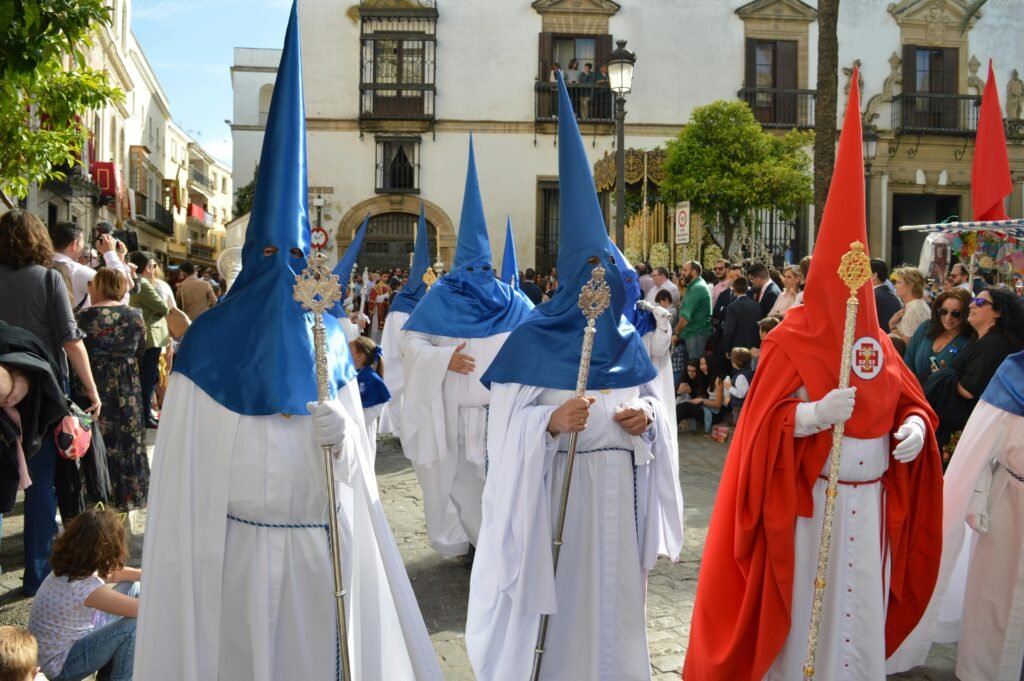
Semana Santa and Religious Festivals in Galicia
In Galicia, religious festivals don’t compete with one another.
They serve different purposes.
Semana Santa sits at the center: the most formal, disciplined, and publicly visible religious observance in the region. Around it are dozens of romerías, saints’ days, and local pilgrimages that matter just as much—though often in smaller, more familiar ways.
To understand religious festivals in Galicia, it helps to see how Semana Santa sets the rhythm, and how everything else moves around it.
Semana Santa in Galicia
Semana Santa is the largest and most formal religious festival in Galicia, but it is rarely the most emotional.
In cities such as Ferrol and Viveiro, Holy Week is taken seriously in a way that is unmistakable but understated. Processions are carefully organized, confraternities are disciplined, and the tone is controlled. Silence matters. Order matters. Excess does not.
What distinguishes Galician Semana Santa is not spectacle, but continuity.
Participation is often inherited rather than chosen. Families belong to confraternities across generations. Roles are learned early and repeated yearly with little commentary. The emphasis is not on individual expression of faith, but on collective maintenance of a structure that already exists.
This is why Galician Holy Week can feel austere to visitors expecting drama. It isn’t designed to impress. It’s designed to endure.
Why It Feels Different from Southern Spain
Comparisons with Andalusia are inevitable—and misleading.
Where southern Semana Santa emphasizes emotion, visibility, and theatrical intensity, Galicia emphasizes containment. Music is sparse. Movement is deliberate. Emotion is present but unperformed.
This difference isn’t regional temperament alone. It reflects a broader Galician approach to religion: faith as obligation rather than declaration.
Holy Week here functions less as a public statement and more as a communal rehearsal—of memory, hierarchy, and restraint.
The Social Role of Semana Santa
Semana Santa also plays a practical role.
It organizes early spring. It marks the end of winter inwardness. It brings people back into shared public space after months of rain and relative isolation. For many, participation has less to do with belief than with return—showing up because one always has.
In this sense, Semana Santa is the backbone of Galicia’s religious calendar. It provides the framework within which other, more fluid festivals operate.
Romerías
If Semana Santa is about control, romerías are about release.
These pilgrimages to rural chapels, hilltop shrines, or coastal sanctuaries expand religious life outward. Walking replaces procession. Eating replaces silence. Music follows prayer without apology.
Romerías such as A Virxe da Barca in Muxía or San Benito de Lérez near Pontevedra matter not because of doctrine, but because they pull people back to places that anchor identity.
Belief varies widely. Attendance does not.
This is religion functioning as return rather than instruction.
Saints’ Days
Beyond major pilgrimages, Galicia’s calendar is dense with saints’ days tied to specific towns, parishes, and needs.
Figures like San Roque, historically invoked against illness, still animate village festivals that combine Mass, music, fireworks, and long meals. These events rarely attract outsiders and make no effort to explain themselves.
Their power lies in scale. They belong completely to the places that celebrate them.
Marian Devotion
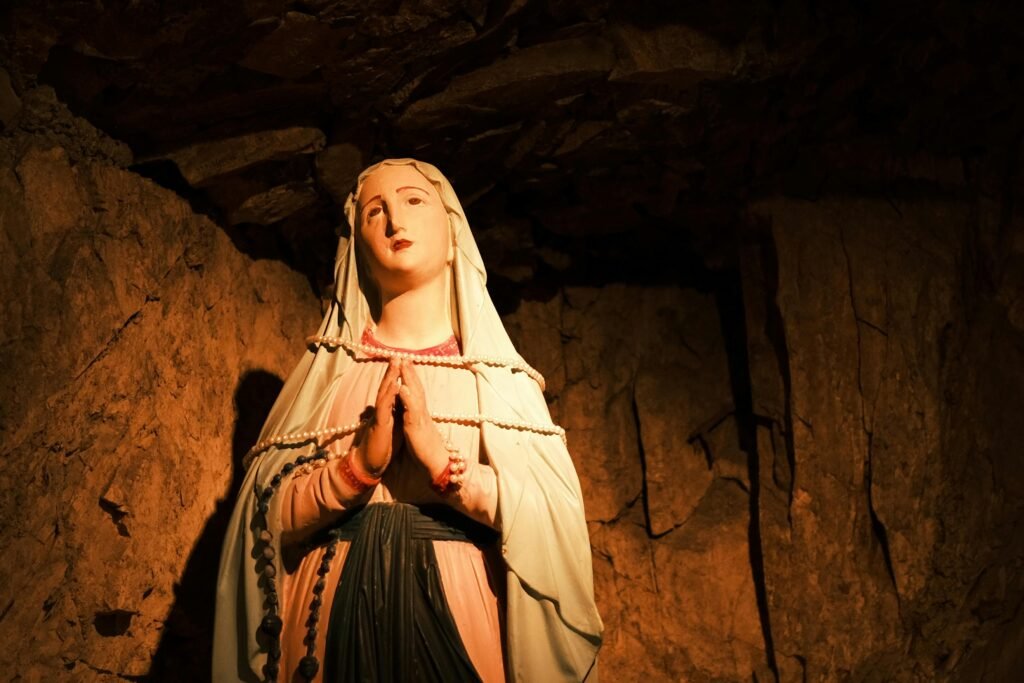
Marian festivals in Galicia tend toward familiarity rather than exaltation.
The Virgin appears less as a triumphant figure than as a constant presence—protector, witness, and point of reference. Processions are calm. Settings do much of the work: coastlines, chapels, forest clearings.
The tone mirrors Galicia’s wider religious sensibility: respectful, unsentimental, and uninterested in display.
Why All of This Still Works
Galicia is increasingly secular in belief, yet religious festivals continue with little friction.
They endure because they:
- structure time
- create reasons to return
- allow participation without ideological alignment
Semana Santa holds the center by preserving form.
Romerías loosen it by inviting movement.
Saints’ days anchor religion to place.
None require certainty. All require presence.
What Visitors Should Understand
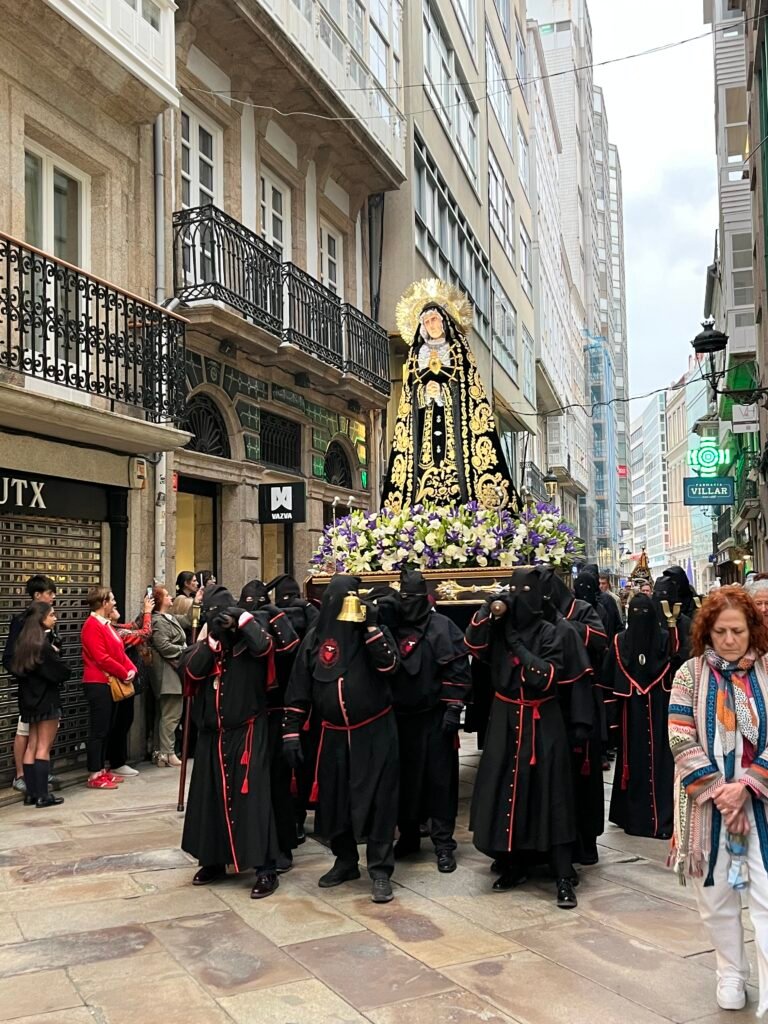
Religious festivals in Galicia are not curated experiences.
There may be no schedule. No narration. No clear entry point. Meaning is assumed, not translated.
Visitors who do best are those who observe before participating and accept that not everything is immediately legible.
Understanding comes slowly—often afterward.
Continuity Over Conviction
Taken together, Galicia’s religious festivals reveal a culture less concerned with belief than with maintenance.
Semana Santa preserves the structure.
Romerías reopen it.
Local festivals keep it grounded.
This is religion practiced as continuity rather than persuasion—and it explains why, here, it still holds.
Related Reading

Festivals in Galicia: How to Choose One Worth Going To

San Juan in Galicia: Fire, Beaches, and the Longest Night

Festivals in Galicia: A Month-by-Month Calendar

Galician Music Festivals: Ortigueira, Noroeste, and Beyond

Village Fiestas in Galicia: What to Expect (and How to Join)

Food-Focused Festivals in Galicia
