
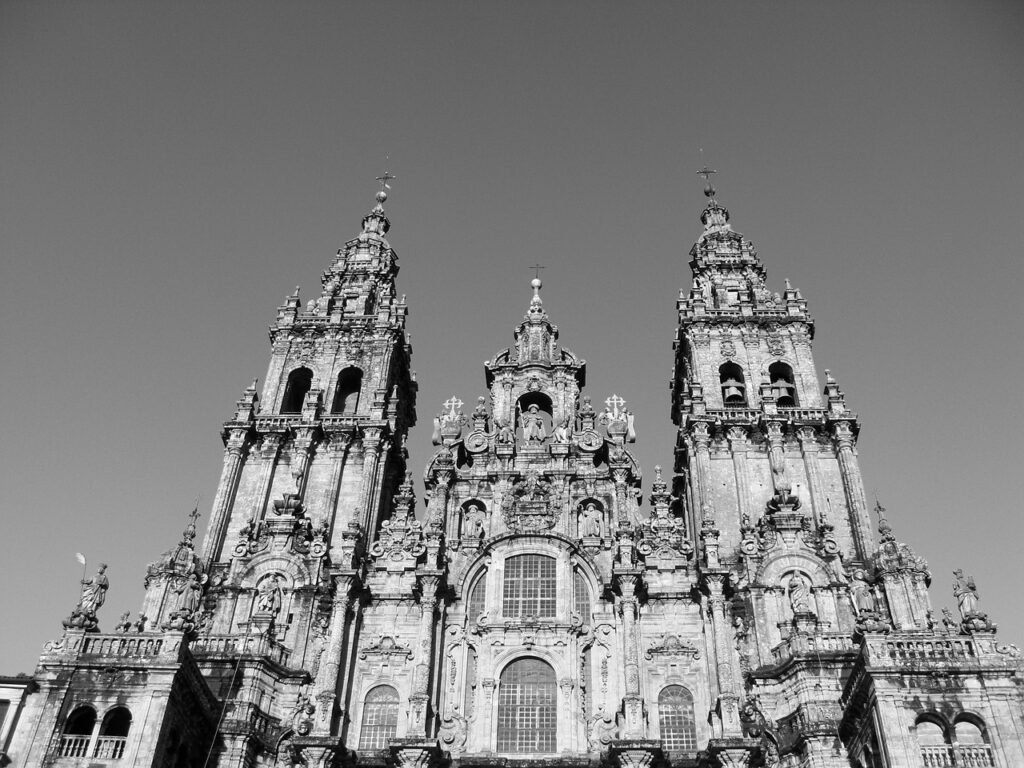
Religion in Galicia: Tradition More Than Belief
In Galicia, religion is rarely argued over.
It’s simply there.
Churches sit at the center of villages whether people attend Mass or not. Saints’ days still shape local calendars. Funerals remain collective, formal affairs even among families who would describe themselves as non-religious. Faith, in the personal sense, often feels muted—but the structures around it remain intact.
To understand religion in Galicia, it helps to stop asking what people believe and start paying attention to what they maintain.
Catholicism as Inheritance, Not Assertion
Galicia’s Catholicism is quiet. There is little of the declarative faith found in parts of southern Spain or Latin America. Few public statements. Few visible certainties. Belief is assumed, then largely left alone.
For many Galicians, religion functions like an inherited language. You may not use it daily, but you know how it works. You recognize the symbols. You understand when it’s appropriate to speak it.
This is why churches can feel both central and underused. Attendance may be irregular, but the building itself remains unquestioned. It anchors weddings and funerals, festivals and farewells. It marks time even when faith itself recedes.
Holy Week, Without Performance
Semana Santa reveals this dynamic clearly.
In Galicia, Holy Week processions tend to be smaller, quieter, and less theatrical than those in the south. There is less spectacle, less intensity, fewer crowds drawn for display alone. The tone is sober, contained, often unmistakably local.
Processions still move through town centers. Images are still carried. Streets still pause. But participation doesn’t necessarily signal fervent belief. More often, it signals continuity—a shared understanding that this is how the year turns.
Semana Santa here feels less like a declaration of faith than an inherited responsibility, handled with restraint.
Saints, Promises, and Practical Faith
Galician religious practice has long been pragmatic.
Saints are approached less as moral authorities than as familiar figures—nearby presences one might appeal to for help with specific concerns. Health, weather, travel, work. The relationship is conversational rather than doctrinal. Promises are made. If something improves, a visit follows. If not, life moves on.
This flexibility matters in a region shaped by uncertainty—by storms, migration, and loss. Religion offers structure without demanding conviction. It adapts easily to doubt.
A Landscape Already Accustomed to the Sacred
Many religious sites in Galicia sit on places that mattered long before Christianity arrived. Springs, stones, hilltops, forest edges. Catholic practice didn’t erase those associations so much as absorb them.
The result is a religious landscape that feels layered rather than rigid. Meaning comes from place as much as from theology. You don’t need strong belief to sense that certain locations carry weight.
Here, religion is spatial before it is ideological. It’s about where you go, not what you assert.
Death Without Distance
Galician cemeteries are often attached directly to churches and woven into everyday movement through towns and villages. They are visited casually, without ceremony or avoidance. Death is acknowledged, not dramatized.
Funerals, especially, reveal how religion functions socially. Even families with little personal faith tend to follow established rituals. Not out of fear or obligation, but because ritual provides a shared script when language fails.
Religion steps in where belief may hesitate.
The Camino and Quiet Faith
The Camino de Santiago passes directly through this understated religious world.
Pilgrims often expect Galicia to feel more overtly devotional. Instead, they encounter something calmer. Locals coexist with the pilgrimage rather than perform it. The Camino is present, but not exalted. It has always passed through—like the weather, like the sea.
This quiet coexistence shapes the Camino’s final days. Less triumph. More arrival.
Why Religion Persists Here
Galicia is increasingly secular in belief, particularly among younger generations. Yet religious structures endure with little resistance.
They endure because they remain useful.
They organize time. They mark transitions. They allow shared participation without requiring agreement. One can engage fully, partially, skeptically, or simply out of habit—and no explanation is required.
Religion survives here precisely because it does not insist.
Tradition, Without Urgency
Religion in Galicia moves at the region’s familiar pace: slow, habitual, resistant to rupture.
Belief may thin or fade.
Tradition holds.
That balance—ritual without pressure, faith without urgency—is what makes Galician religiosity distinctive. It explains why religion remains visible here even as certainty quietly recedes.
Related Reading

The Galician Language Explained

Galicia’s Celtic Heritage: What It Really Means Today

Everyday Life in Galicia: Pace, Meals, and Social Rituals

The Sea in Galician Culture: Coast, Weather, and Mentality
