
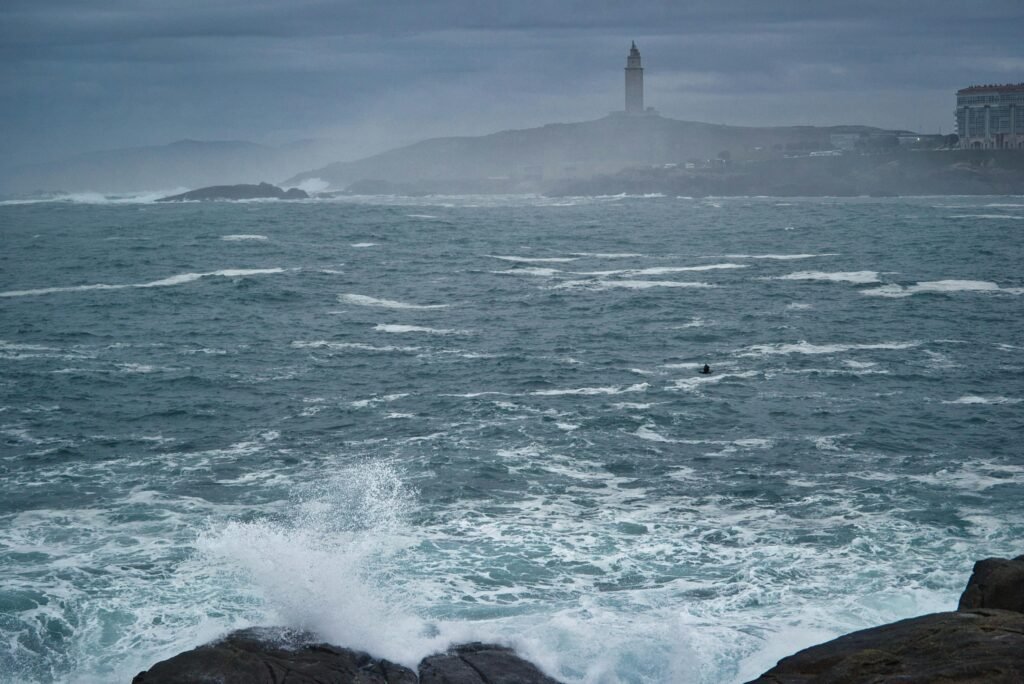
Living with the Atlantic: The Sea’s Role in Galician Life
In Galicia, the sea is not scenery.
It is presence.
It shapes how towns are built, how days are paced, how people speak about risk, loss, and patience. Even far inland, the Atlantic is felt—in weather, in food, in language, in temperament.
To understand Galicia, you have to understand its relationship with the sea. Not as romance or livelihood alone, but as a long, negotiated coexistence.
A Coast That Defines the Interior
Living with the Rías
Galicia’s coastline is carved into deep estuaries known as rías—long fingers of seawater that reach inland, blurring the boundary between land and ocean.
These rías:
- shelter fishing communities
- moderate the climate
- shape settlement patterns
They also dissolve the idea of a clean divide between coastal and inland Galicia. The sea doesn’t stop at the shore. It moves inward, geographically and culturally.
That permeability is key to understanding Galician mentality.
Villages Facing the Water
Unlike Mediterranean coastal towns built for leisure and visibility, many Galician fishing villages turn inward. Harbors are functional. Houses are compact. The sea is worked, not admired.
This orientation reflects respect rather than intimacy. The Atlantic is generous, but it is never assumed to be safe.
Weather as a Cultural Force
Rain, Wind, and Uncertainty
Galicia’s weather is famously changeable:
- rain arrives without drama
- fog rolls in and out
- wind shifts quickly
Over time, this unpredictability shapes behavior. Plans are flexible. Certainty is provisional. People adapt rather than insist.
The result is a culture comfortable with contingency.
Patience Over Control
Where climates are stable, control becomes an expectation.
In Galicia, patience is the more reliable strategy.
This mindset extends beyond the sea:
- in agriculture
- in social arrangements
- in everyday pacing
Weather teaches restraint. The sea reinforces it.
The Sea and Work: Respect Without Illusion
Fishing as Risk, Not Folklore
Fishing has long been central to Galicia’s economy, but it has never been romanticized locally.
Shipwrecks, storms, and loss are part of collective memory. Many coastal families carry stories of absence—men who didn’t return, boats that never made it back.
This history produces a particular form of seriousness:
- pride without bravado
- tradition without nostalgia
- skill without spectacle
The sea is not an identity accessory. It is a condition.
Women, Shore, and Structure
Historically, much of the visible coastal labor—shellfish gathering, net repair, fish markets—has been done by women.
Their work is methodical, regulated by tides and seasons rather than clocks. It reinforces a coastal culture built on attention and timing, not speed.
This division of labor further anchors Galician society to natural cycles rather than abstract schedules.
Mentality Shaped by the Atlantic
Distance, Reserve, and Observation
Galicians are often described as reserved. The sea helps explain why.
A culture shaped by weather and water tends to value:
- observation before action
- understatement over declaration
- caution without fear
This is not emotional distance. It is attentiveness.
The Atlantic teaches that not everything announces itself in advance.
Melancholy Without Drama
There is a word often used—sometimes lazily—to describe Galicia: melancholic.
What’s more accurate is reflective.
The sea introduces:
- long horizons
- waiting
- repetition
These produce introspection, not despair. Sadness, when it appears, is integrated rather than performed.
Inland Galicia Is Still Maritime
Even away from the coast, the sea remains present:
- in seafood traditions
- in weather patterns
- in language and metaphor
Markets inland sell fish as routinely as vegetables. Storms shape conversations. The Atlantic remains the reference point, even when unseen.
Galicia is not split between land and sea cultures. It is a maritime region with an interior.
The Sea on the Camino
For Camino walkers, especially those arriving from drier parts of Spain, Galicia often feels like a transition.
The air changes. Light softens. Rain becomes ordinary. Pace slows.
This isn’t incidental. The Camino’s final stretch passes through a landscape shaped by Atlantic logic—where endurance matters more than urgency, and adaptation matters more than control.
Many pilgrims feel this shift instinctively, even if they don’t name it.
A Relationship Without Sentimentality
Galicia does not idealize the sea.
It negotiates with it.
The Atlantic is:
- a provider
- a threat
- a constant
It demands humility, attention, and acceptance of limits. In return, it offers continuity rather than certainty.
That exchange—unequal but enduring—has shaped Galician culture for centuries. To understand Galicia, you don’t need to romanticize the sea.
You only need to recognize how deeply it is woven into everyday life.
Related Reading

The Galician Language Explained

Galicia’s Celtic Heritage: What It Really Means Today

Everyday Life in Galicia: Pace, Meals, and Social Rituals

Religion in Galicia: Tradition More Than Belief
