
Galicia’s Celtic Heritage: What It Really Means Today
By Luis Miguel Bugallo Sánchez (Lmbuga) – Own work, CC BY-SA 4.0, https://commons.wikimedia.org/w/index.php?curid=38709081
Galicia is often described as Celtic Spain.
It’s an idea that feels immediately right—and, historically speaking, slightly wrong.
Bagpipes echo through village festivals. Pre-Roman hillforts crown windswept headlands. The landscape is wet, green, and Atlantic rather than Mediterranean. To outsiders, the parallels with Ireland or Brittany seem obvious.
But Galicia’s relationship with its Celtic past is more complex than the label suggests. It isn’t a living fossil of Iron Age Europe, nor a modern invention designed for tourism. It sits somewhere in between: grounded in real history, reshaped by centuries of change, and still quietly present in how Galicia understands itself today.
This is what Galicia’s Celtic heritage actually means—and why the distinction matters.
The Atlantic Roots: What the Archaeology Supports
The Castro World of Iron Age Galicia
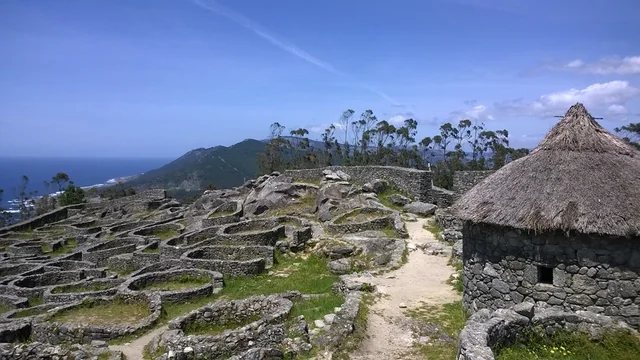
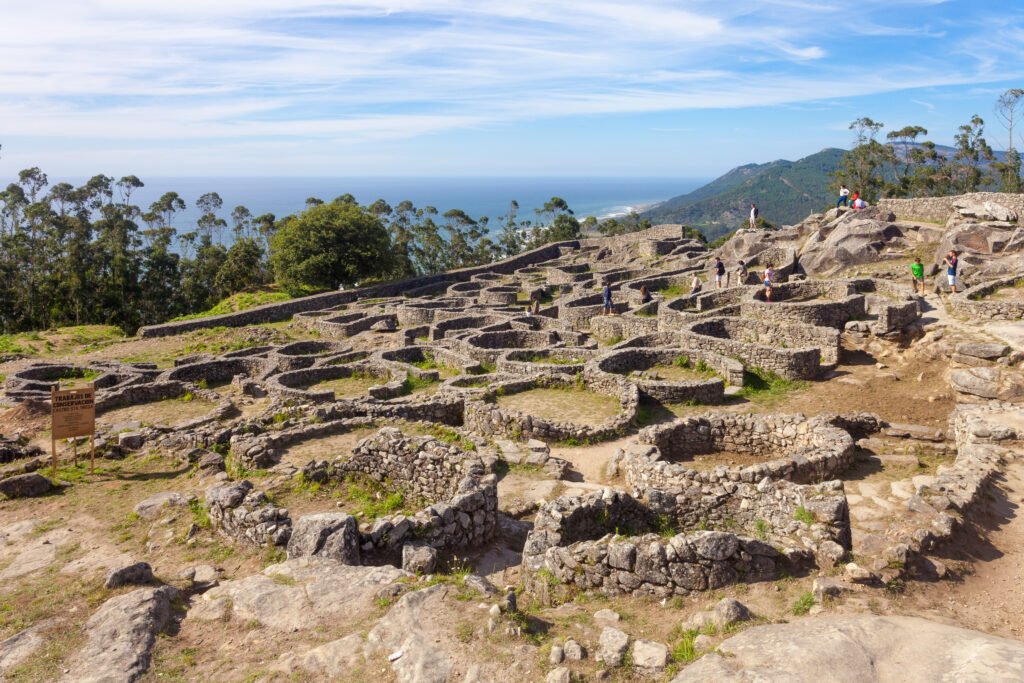
Before Roman conquest, northwestern Iberia was dominated by what archaeologists call the castro culture: fortified hilltop settlements spread across present-day Galicia.
These communities shared clear traits with Atlantic Iron Age societies elsewhere in Europe:
- Circular stone dwellings
- Defensive elevated sites
- Clan-based social structures
- Maritime trade networks along the Atlantic coast
Similar settlements appear in Ireland, western Britain, and Brittany. This doesn’t mean Galicia was “Celtic” in a neat, unified sense—but it was part of the same Atlantic cultural zone that later became associated with Celtic identity.
That connection is real, and it’s archaeological rather than mythical.
Why the Language Didn’t Survive
Here’s where Galicia diverges sharply from places like Ireland or Wales.
Romanization in Galicia was deep and effective:
- Latin replaced pre-Roman languages
- Over time, Latin evolved into Galician and Portuguese
- No Celtic language survived into the medieval period
This matters because language is often the strongest marker of Celtic continuity elsewhere in Europe. In Galicia’s case, the break was decisive.
Galicia’s Celtic heritage is therefore material and cultural, not linguistic—and any serious discussion has to acknowledge that limit.
What Most People Get Wrong About “Celtic Galicia”
Before going further, it’s worth clearing up a few persistent misunderstandings.
- Galicia is not a Celtic nation in the modern political or linguistic sense.
- Its Celtic identity is not an unbroken survival from antiquity.
- The similarities with Ireland or Scotland are structural and Atlantic, not identical.
What Galicia is—and this is the crucial point—is Atlantic in orientation in a country largely shaped by Mediterranean history. That difference explains far more than the word Celtic ever could on its own.
Breogán: Myth, Memory, and Galician Self-Image
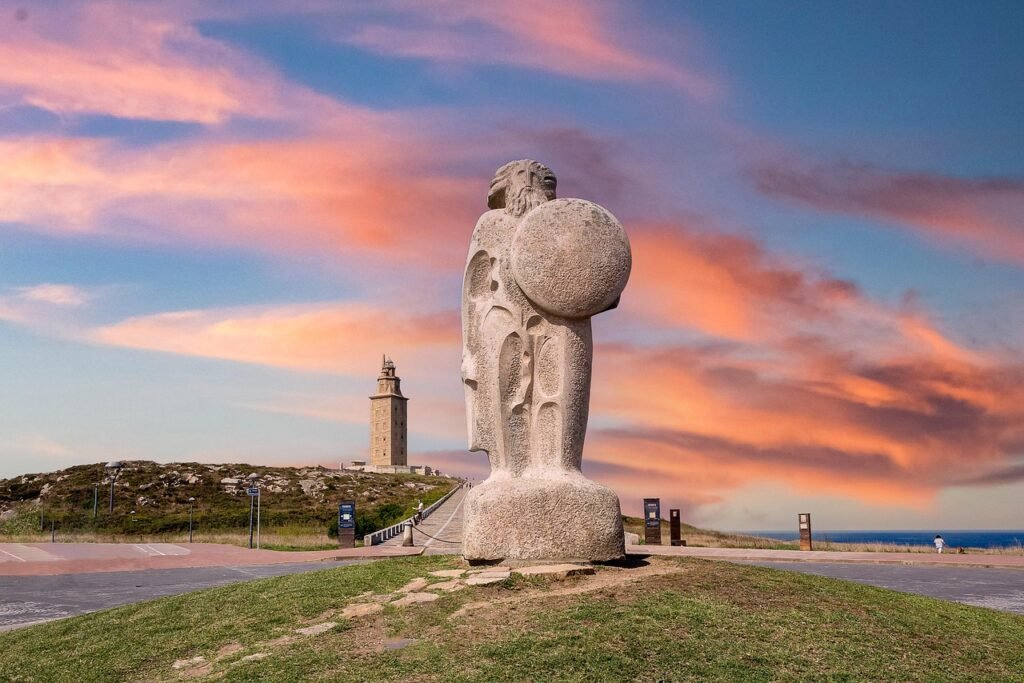
No discussion of Galicia’s Celtic identity is complete without Breogán.
According to medieval Galician legend, Breogán was a Celtic king who founded a great city on the Atlantic coast and built a towering lighthouse from which his sons could see Ireland. From there, the story goes, his descendants crossed the sea and settled the island—making Galicia the mythic homeland of the Irish.
The legend was written down centuries after the events it claims to describe, most famously in the Lebor Gabála Érenn (The Book of Invasions). It is not archaeology. It is not history.
But it matters.
Breogán represents something deeper than literal belief: a narrative of Atlantic connection, sea-facing identity, and outward movement rather than isolation. He is a symbolic ancestor, not a factual one.
In A Coruña, the ancient Roman lighthouse—now known as the Tower of Hercules—is popularly associated with Breogán’s mythical tower. The association is retrospective and imaginative, but it has endured because it resonates with how Galicia understands itself: old, maritime, and culturally distinct.
Importantly, modern Galicians don’t invoke Breogán naively. He appears:
- in literature and poetry
- in nationalist symbolism
- in school curricula as legend, not fact
His role is explanatory rather than deceptive. Breogán gives Galicia a story of origin that points outward to the Atlantic, rather than inward to the Iberian interior.
That symbolic orientation helps explain why the idea of Celtic Galicia persists even when historians are careful with the term.
Symbols That Endured (and Evolved)
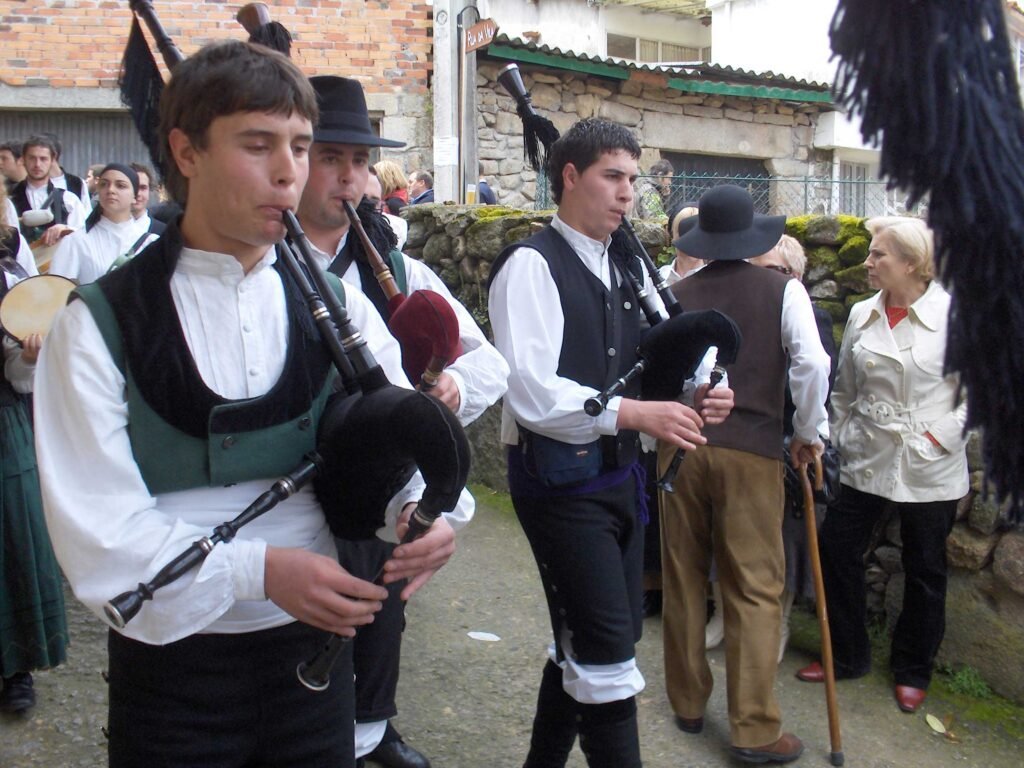
The Gaita: More Than a Stereotype
The gaita gallega, Galicia’s bagpipe, is often treated as a novelty or proof of Celtic ancestry. In reality, it functions more as a modern cultural anchor than a museum relic.
Bagpipes exist across Europe, but in Galicia the gaita became:
- a symbol of rural continuity
- a marker of regional pride
- a sonic link to the Atlantic world
Its prominence today reflects revival and reinterpretation as much as ancient practice. That doesn’t weaken its meaning—it explains why it still resonates.
Sacred Landscapes and Layered Belief
Galicia’s countryside is dense with pre-Christian echoes:
- Springs associated with healing
- Stones linked to fertility or protection
- Forests tied to legend rather than doctrine
Instead of erasing these beliefs, Christianity absorbed them. The result is a religious landscape that feels unusually porous, where saints’ shrines and ancient rituals quietly coexist.
This continuity of place-based belief is one of the most tangible survivals of Galicia’s deep past.
The Celtic Revival: Identity Reclaimed, Not Invented
Much of what people now recognize as Celtic Galicia was sharpened during the 19th and 20th centuries.
In periods of political centralization—especially under Franco—Galicia’s intellectual and cultural movements looked outward to:
- Ireland
- Brittany
- other Atlantic regions with strong local identities
This alignment wasn’t fabricated. It was selective and strategic: a way to articulate difference within Spain using a vocabulary rooted in history.
The result is a cultural identity that is consciously maintained, not accidentally preserved.
How Celtic Heritage Shows Up in Galicia Today
Music, Festivals, and Confidence
Traditional Galician music still draws heavily on Atlantic forms:
- modal scales
- communal rhythms
- dance styles shared across coastal Europe
What’s notable is the absence of nostalgia. These traditions aren’t performed as reenactment—they’re part of contemporary life, especially in rural Galicia.
There’s confidence here, not costume.
The Camino de Santiago and the Atlantic Mood
The Camino is a Christian pilgrimage, but its final stages pass through landscapes shaped long before Christianity arrived.
For many pilgrims, Galicia feels different:
- wetter
- quieter
- more introspective
- less performatively Mediterranean
That atmosphere—often labeled “Celtic”—comes from climate, geography, and historical layering rather than myth. It’s one reason the final days of the Camino feel emotionally distinct, even for secular walkers.
So What Does Galicia’s Celtic Heritage Really Mean?
Galicia’s Celtic heritage is not a claim to purity or antiquity.
It is:
- a real Atlantic Iron Age foundation
- a culture shaped decisively by Rome and Christianity
- a modern identity built with historical awareness
In short, Galicia isn’t Celtic in the way Ireland is—but it is Atlantic in a way most of Spain is not.
Understanding that distinction matters. It prevents caricature, deepens travel experiences, and explains why Galicia feels subtly but unmistakably different the moment you arrive.
Related Reading

The Galician Language Explained

Everyday Life in Galicia: Pace, Meals, and Social Rituals

The Sea in Galician Culture: Coast, Weather, and Mentality

Religion in Galicia: Tradition More Than Belief
