
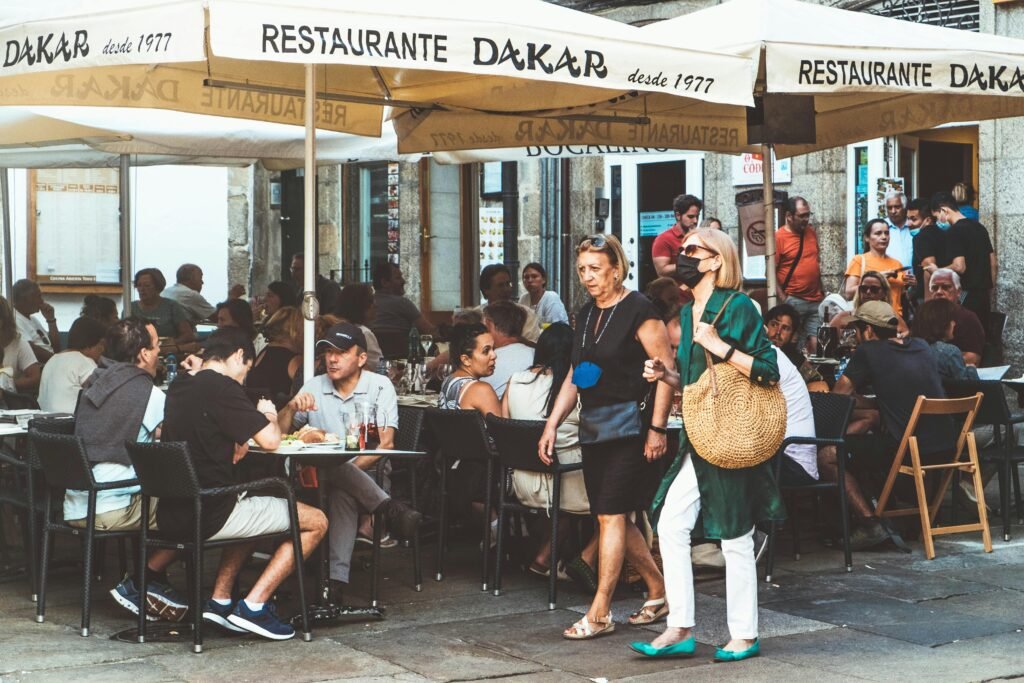
Everyday Life in Galicia: Pace, Meals, and Social Rituals Today
Galicia doesn’t announce itself loudly.
It reveals itself through rhythm rather than spectacle.
For visitors used to faster, more performative versions of Spain, daily life in Galicia can feel understated at first. Shops open later. Meals stretch. Conversations drift. Time feels elastic, but not unfocused.
This isn’t laziness or nostalgia. It’s a lived system—shaped by climate, history, and habit—that still governs how people move through the day.
Understanding Galicia means understanding its pace, its meals, and the quiet rituals that hold everyday life together.
A Slower Pace
Galician days are organized less by the clock than by sequence.
A typical rhythm looks like this:
- a gradual morning build
- a midday focus on lunch
- a slowed or paused afternoon
- an evening return to social life
Work happens, but it bends around meals rather than the other way around. Lunch is not an interruption to the day; it is the day’s central marker.
What visitors sometimes read as inefficiency is better understood as continuity.
Climate as Culture
Galicia’s Atlantic climate quietly reinforces this rhythm:
- frequent rain discourages rushing
- fertile land supports food-centered routines
- long evenings invite lingering
Daily life adapts to conditions instead of pushing against them. Over time, that adaptation becomes habit—and then culture.
Meals as Structure, Not Indulgence
Lunch Is the Anchor
In Galicia, lunch is not flexible.
Between roughly 2:00 and 4:00 p.m.:
- small businesses close
- streets thin
- restaurants fill
A weekday lunch commonly includes multiple courses, bread, and wine or water, followed by conversation. This isn’t reserved for weekends or celebrations. It’s routine.
Lunch is where the day is processed—socially as much as physically.
Dinner: Later, Simpler
Dinner comes late, often after 9:00 p.m., but it is usually lighter than lunch.
Meals tend toward:
- shared plates
- simple proteins or leftovers
- informal settings
Dinner closes the day without reopening it.
Bars, Cafés, and Casual Presence
Bars as Social Infrastructure
Galician bars are not destinations. They’re extensions of daily life.
People stop in briefly and repeatedly, often without a clear reason. A coffee, a glass of wine, or a few minutes of conversation is enough.
Being present matters more than consuming.
Conversation Without Urgency
Conversation tends to be observational and local. Weather, food, neighbors, minor inconveniences—these aren’t filler topics. They’re connective tissue.
The point isn’t information. It’s recognition.
Social Rituals That Don’t Announce Themselves
Greetings That Pause
Greetings in Galicia are rarely abrupt. Even brief encounters often include a pause, a question, or a short exchange—especially outside larger cities.
Skipping this step can feel off, not because of strict etiquette, but because it breaks the expected rhythm of acknowledgment.
The Evening Walk (Paseo)
The paseo, an unhurried evening walk, remains quietly important across Galicia.
It serves several purposes at once:
- digestion after dinner
- casual social contact
- marking the transition from day to night
There is no destination. The walk itself is the ritual.
Urban and Rural: Different Speeds, Same Logic
Cities like A Coruña or Vigo move faster, but the underlying structure remains intact.
Even in urban settings:
- lunch still dominates the day
- evenings remain social
- bars function as communal space
In rural areas, the same patterns are simply more visible and less interrupted.
The difference is tempo, not philosophy.
Why This Matters for Visitors—and Pilgrims
Many travelers, especially Camino walkers, sense that Galicia feels different but struggle to name why.
The difference isn’t just landscape. It’s behavioral.
Galicia doesn’t reward urgency. It rewards alignment.
Those who slow their meals, accept pauses, and linger without agenda often find the region unexpectedly open. Those who resist the rhythm tend to feel subtly out of sync.
This isn’t judgment. It’s cultural mechanics.
Everyday Life, Intentionally Understated
Daily life in Galicia isn’t built around novelty or performance.
It rests on:
- repetition
- familiarity
- shared time
The result is a culture that doesn’t present itself for consumption but remains coherent for those who live within it.
Once the rhythm becomes visible, Galicia makes sense.
And once it makes sense, it tends to stay with you.
Related Reading

The Galician Language Explained

Galicia’s Celtic Heritage: What It Really Means Today

The Sea in Galician Culture: Coast, Weather, and Mentality

Religion in Galicia: Tradition More Than Belief
